












The battle for the top of Google is no longer just about the #1 blue link. It’s about becoming the answer itself.
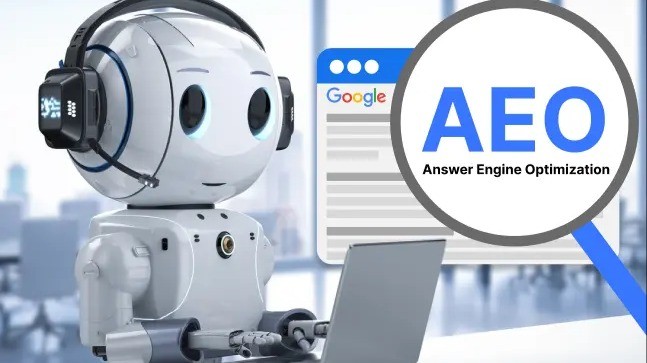
This guide breaks down everything you need to know about Answer Engine Optimization (AEO). We’ll move beyond traditional SEO and show you exactly what AEO is and why it’s so important for winning featured snippets and voice search results. You’ll get a step-by-step strategy to make your content visible in our new AI-driven search world.
What is Answer Engine Optimization (AEO)? The Evolution of Search
At its core, Answer Engine Optimization is about creating and structuring your content to give direct answers to users’ questions. It’s the key to appearing in special search features.
AEO vs. SEO: What’s the Real Difference?
Think of AEO as a specialized part of your overall SEO strategy.
- SEO (Search Engine Optimization) is the broad practice of getting your website to rank higher in the traditional search results.
- AEO (Answer Engine Optimization) focuses specifically on winning spots in answer-focused features like Featured Snippets and voice search replies.
While SEO gets you on the page, AEO gets you featured at the very top as the definitive answer.
How Search Engines Became Answer Engines: From Keywords to Conversations
Years ago, search engines like Google and Bing were like digital librarians. You gave them keywords, and they gave you a list of books (webpages).
Today, they are more like expert concierges. You ask a question, and they give you a direct answer. This shift happened because search engines now understand context and intent, not just keywords. They want to end the user’s journey as quickly and helpfully as possible.
Understanding SERP Features: Featured Snippets, Knowledge Graph, and PAA
When you search for something, you see more than just a list of blue links. These special results on the Search Engine Results Pages (SERPs) are where AEO shines.
- Featured Snippets: The answer box at the top of the results, often called “Position Zero.”
- Knowledge Graph: A panel on the side that provides quick facts about a person, place, or thing.
- People Also Ask (PAA): A box of dropdown questions related to your original search.
The Impact of Zero-Click Searches on Your Strategy
A “zero-click search” happens when a user gets their answer directly on the search results page without clicking any links.
While this might sound scary, it’s actually a huge opportunity. By winning these answer spots, you build incredible brand awareness and establish yourself as the go-to authority. The user sees your brand name right next to the helpful answer.
Why AEO is Crucial for Your SEO Strategy in the AI Era
Focusing on an AEO strategy gives you a major advantage. It’s not just about ranking; it’s about becoming the trusted source of information.
How to Rank for Featured Snippets and Own Position Zero
Owning the featured snippet means your answer is the first thing a user sees. This drives visibility and positions your brand as a leader. It’s prime real estate on Google, and AEO is the key to securing it.
Optimizing Content for Voice and AI Answers (Siri, Alexa, Google Assistant)
How do you optimize for voice search SEO? By answering questions clearly.
When someone asks Siri, Alexa, or Google Assistant a question, the device reads a direct answer aloud. That answer almost always comes from a featured snippet. Optimizing for AEO means your content is ready to be the go-to source for millions of voice-activated devices.
Building Unshakeable Brand Authority and E-E-A-T
Google rewards content that demonstrates Experience, Expertise, Authoritativeness, and Trustworthiness (E-E-A-T).
When your content is consistently chosen as the best answer, you send powerful trust signals to Google. It proves you are an authority in your field, which helps all your other SEO efforts.
The Future is Here: AEO’s Role in Google’s AI Overviews
AI is changing search. Google’s new AI Overviews create summary answers based on the best information available.
By having clear, well-structured, and factual answers on your site, you provide the perfect source material for these AI-powered summaries. An AEO strategy is the best way to future-proof your content.
A 5-Step AEO Strategy for Featured Snippets & Voice Search SEO
Ready to get started? Here’s a practical framework for implementing answer engine optimization.
Step 1: Uncover Question Keywords & User Intent
First, you need to know what questions your audience is asking. Don’t just guess.
Use tools like Semrush and Ahrefs to find keywords phrased as questions (who, what, why, how). You can also browse forums like Quora and Reddit to see the exact language your customers use. Understanding user intent is everything.
Step 2: Structure Content for Direct Answers with the Inverted Pyramid Style
Journalists use a method called the “Inverted Pyramid Style,” and it’s perfect for AEO.
- Start with the answer: Provide a direct, concise answer to the main question right away, in the first paragraph.
- Add important details: Follow up with the most important supporting information.
- Provide general context: End with background information and related details.
Step 3: Master On-Page SEO for Answer Engines
Your on-page SEO needs to be crystal clear.
- Use the target question as your heading (H2 or H3).
- Provide a short, direct answer (40-50 words) right below the heading.
- Use simple language that everyone can understand.
- Break up complex ideas into lists or short paragraphs.
Step 4: Implement Structured Data with Schema Markup
Schema markup is a type of code that helps search engines understand your content better. Think of it as labeling your content for Google.
For AEO, a few types of schema are especially powerful:
- FAQ Schema: Marks a list of questions and answers.
- How-To Schema: Outlines a step-by-step process.
Implementing this correctly is a technical task. At ITXITPro, our web development team specializes in this, ensuring our clients’ WordPress, Shopify, or custom-built sites are perfectly optimized for search engines.
Step 5: Fortify Your E-E-A-T Signals to Build Trust with Google
Google needs to see you as a credible source. You can build this trust by:
- Including author bios with credentials.
- Citing reputable sources and data.
- Making your contact information easy to find.
- Showcasing customer reviews and testimonials.
Answer Engine Optimization Best Techniques & Advanced Tactics
Once you have the basics down, you can use these advanced tactics to get an edge.
Formatting for Snippets: Using Lists, Tables, and Concise Paragraphs
Google loves well-formatted content for its featured snippets.
- Numbered and Bulleted Lists: Use these for steps, processes, or lists of items.
- Tables: Use tables to organize data or comparisons.
- Short Paragraphs: Keep paragraphs to 2-3 sentences. This makes your content easy to scan and pull answers from.
Leveraging ‘People Also Ask’ (PAA) to Guide Your Content
The “People Also Ask” section on Google is a goldmine for content ideas.
Type your main keyword into Google and look at the PAA box. These are the real questions people are asking. Answer each of these questions within your article to create a truly comprehensive resource.
Writing in Natural Language for Voice and AI Search
Write the way people talk.
Avoid corporate jargon and overly complex sentences. Use a conversational tone. This makes your content more accessible and a much better fit for voice search queries, where users speak naturally.
Optimizing for Local SEO: Winning Answers on Google Maps
AEO is also critical for local businesses. Many “near me” searches are questions, like “best pizza near me” or “what time does the hardware store open?”
The answers often come from a well-optimized Google Business Profile. Ensure your profile is complete, with accurate hours, a description, photos, and positive reviews. As a Toronto-based agency, ITXITPro helps local businesses optimize their digital presence to capture these valuable local customers.
Essential Tools for Your AEO Toolkit
You don’t have to do this alone. The right tools make answer engine optimization much easier.
Top Tools for Finding Question-Based Keywords
- Semrush & Ahrefs: Industry-leading tools for in-depth keyword research.
- AnswerThePublic: Visualizes the questions people are asking around a keyword.
- AlsoAsked: Scrapes PAA data to give you endless question ideas.
Schema Markup Generators and Validators
- Schema Markup Generators: Tools that help you create the code without writing it from scratch.
- Google’s Rich Results Test: A free tool to check if your schema is implemented correctly.
- All in One SEO (AIOSEO): A powerful WordPress plugin that makes adding schema easy.
How to Track Your Featured Snippet Performance
Use a rank tracking tool (like the ones in Semrush or Ahrefs) to monitor your target keywords. These tools will show you not only your ranking but also if you own any SERP features, including featured snippets.
Conclusion
The shift from search engine to answer engine is complete. To succeed today, you have to provide the best, clearest answers to your audience’s questions.
By focusing on user intent, structuring your content for direct answers, using Schema markup, and building E-E-A-T, you can master Answer Engine Optimization. A proactive AEO strategy will help you win today’s featured snippets and prepare you for success in the AI-driven future of search.
Stop trying to just rank; start aiming to be the definitive answer.
Frequently Asked Questions (FAQs)
- What is the main difference between AEO and SEO?
SEO (Search Engine Optimization) focuses on ranking a webpage in the traditional search results. AEO (Answer Engine Optimization) is a subset of SEO that focuses specifically on providing direct, concise answers to user queries to appear in SERP features like Featured Snippets, PAA boxes, and voice search results. - How do you optimize for a Featured Snippet?
To optimize for a featured snippet, identify a common question your audience asks, provide a clear and concise answer (40-50 words) directly below the heading, use structured formatting like lists or tables, and implement relevant Schema markup to help search engines understand your content. - Is AEO the new SEO?
AEO is not a replacement for SEO but rather its natural evolution. While foundational SEO practices are still crucial, AEO represents a strategic focus required to win in modern SERPs dominated by direct answers, zero-click searches, and AI-generated results. - What is the most important factor for Answer Engine Optimization?
While technical aspects like Schema are important, the most critical factor is deeply understanding user intent. You must identify the specific question a user is asking and provide a clear, accurate, and well-structured answer that fully satisfies their query. - What are some examples of answer engines?
Google is the primary example, but others include Bing, Yahoo, and voice assistants like Siri, Alexa, and Google Assistant. All of these platforms aim to provide direct answers instead of just links. - How does voice search affect SEO?
Voice search prioritizes conversational, question-based queries. It heavily favors content that is structured to provide quick, direct answers, making AEO techniques like FAQ pages and concise summaries more important than ever. - Does Schema markup guarantee a featured snippet?
No, Schema markup does not guarantee a featured snippet. It simply helps search engines better understand the context of your content, which increases your chances of being featured. The quality and clarity of your content remain the most important factors. - What is a zero-click search?
A zero-click search is when a user finds the answer to their query directly on the search results page and doesn’t need to click through to a website. These answers typically appear in Featured Snippets, PAA boxes, or the Knowledge Graph. - How long should an answer for a featured snippet be?
The ideal length for a paragraph-based featured snippet is between 40 and 60 words. The key is to be concise and directly answer the user’s question. - Can small businesses compete for featured snippets?
Absolutely. Featured snippets are awarded based on the quality and clarity of the answer, not the size of the website. A small business that creates highly helpful, well-structured content can often outrank larger competitors for specific questions.